Managing admissions is not just about collecting student enquiries. The real challenge begins after an enquiry arrives. A school may forget to call a parent back. A college may have leads scattered across different spreadsheets. A university may struggle to manage thousands of enquiries across multiple courses. A coaching institute may lose a student because its counselor responded too late. An education consultant may forget an important application follow-up. These are the areas where an education CRM system is essential to manage everything smoothly.
These small gaps can eventually turn into lost admissions.
An Education CRM helps solve these everyday problems. A CRM system for educational organizations will manage the enquiries, student information, communications, counselors, applications, and follow-ups in such a manner that each prospective student receives appropriate attention.
Why Schools, Colleges and Universities Struggle with Admissions
Every educational institution has its own way of admitting students, and there are different problems to overcome.
Many times, institutions face issues related to the parent’s communication process. They can call on the phone, use the website, or even use social media platforms, and even visit the campus. In case the communication is done manually, there could be issues related to tracking the callbacks, admission forms, documents, and communications.
The best CRM software for schools can help with all the parent and student communication processes.
Colleges usually struggle with scattered leads. The inquiries could come through websites, education portals, advertisements, events, social media, or walk-ins. If the university lacks a CRM system, the admission team could waste a lot of time compiling information and determining if all leads have been reached out to.
Universities face an issue of scalability. They could be handling various campuses, programs, admissions campaigns, departments, and many potential students at the same time.
A CRM for universities can organize enquiries according to programmes, locations, admission stages, and other relevant factors. This makes customer relationship management in higher education more structured.
The best CRM for higher education should also help teams track applications, counselor interactions, documents, payments, and enrollment progress instead of maintaining each activity separately.
Coaching Institutes and Education Consultants Face Different Challenges
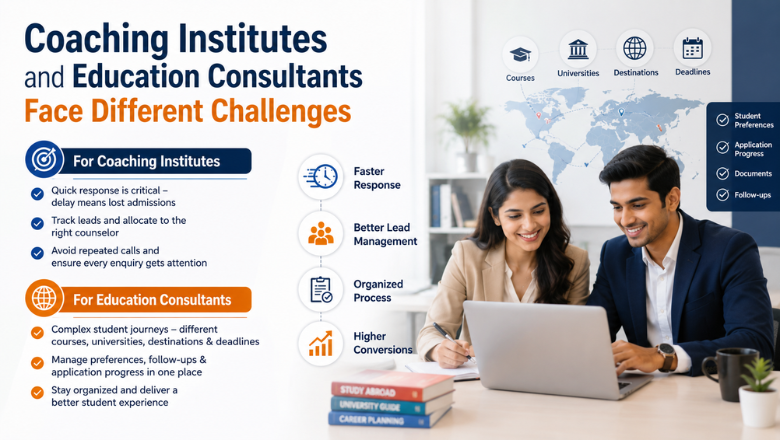
For coaching institutions, one of the biggest hurdles is that of response time.
A prospective student who is looking for an admission test, a competition test, or a professional program will contact many coaching institutions in a day. In case of a late reply from any institution, chances are high that the student might be enrolled in another institution.
Using a CRM makes it easier to track such leads and even allocate them to a counselor. It is also easy to differentiate between leads and prospective enrolled students.
Another problem is repeated calling. Without proper records, two counselors may contact the same student while another promising enquiry receives no attention.
Education consultants face an entirely different level of complexity.
Every student may have a different course, university, destination, budget, intake, document requirement, and application deadline.
The best CRM for education consultancy helps bring these different student journeys into a structured system.
Swift Dial is the best CRM for education consultants, can help counselors maintain student preferences, previous conversations, pending follow-ups, and application progress. Instead of searching through WhatsApp conversations, spreadsheets, emails, and handwritten notes, counselors can work with more organized information.
For consultants handling a high volume of students, this can significantly reduce everyday confusion.
How Does an Education CRM Solve These Problems?
The first problem an education CRM addresses is scattered enquiries.
A CRM for educational institutions can centralize leads coming from websites, landing pages, campaigns, education portals, WhatsApp, events, webinars, and offline sources. This reduces manual data entry and lowers the risk of enquiries being overlooked.
The next problem is missed follow-ups.
Imagine a student saying, “I am interested, but call me on Friday.”
By Friday, the counselor had received 50 new enquiries. Without a structured system, that promising student can easily be forgotten.
CRM helps organize follow-ups and communication so counselors know which students still require attention.
For universities, lead allocation is equally important. Students can be organized based on course interest, campus preference, location, qualification, lead source, engagement, or admission stage.
This makes customer relationship management in higher education easier even when several counselors are handling large enquiry volumes.
The best CRM for higher education should also solve the problem of application visibility. Admission teams need to know whether an application is complete, documents are pending, an interview needs to be scheduled, payment is due, or enrollment is confirmed.
For schools, the best CRM for schools should simplify parent communication and admission follow-ups rather than add unnecessary complexity.
For consultants, the best CRM for education consultancy should help manage individual student journeys, while a CRM for education consultants should give counselors a clear picture of what each student needs next.
What Should You Expect from a Good Education CRM?
A good education CRM should solve practical admission problems, not simply store student data. The best CRM for schools should make parent and admission management simple. A CRM for universities should be capable of handling large and complex admission pipelines.
Similarly, effective customer relationship management in higher education should give admission teams better student context and management better performance visibility. The best CRM for higher education should ultimately help institutions improve both operational efficiency and the prospective student experience.
It should help institutions:
- Capture enquiries from different channels without losing leads.
- Keep student and parent information in one organized system.
- Assign leads to the appropriate admission counselor.
- Schedule and manage important follow-ups.
- Maintain communication history for better conversations.
- Track applications, documents, interviews, payments, and enrollments.
- Reduce repetitive administrative work through automation.
- Measure lead sources, counselor productivity, conversions, and enrollment trends.
The best CRM for education consultancy should make personalized counseling easier to manage, while a CRM for education consultants should ensure that important calls, applications, and student follow-ups do not get buried under new enquiries.
The same principle applies to every CRM for educational institutions: technology should make admissions easier for the people using it.
A student enquiry should never disappear simply because someone forgot to update a spreadsheet. A parent should not have to explain the same requirement to three different people. And a counselor should not have to search through hundreds of messages to remember what happens next.
A good education CRM like Swift Dial can turn these disconnected admission activities into one clear journey from the first enquiry to final enrollment.
Make Every Student Enquiry Count with Swift Dial
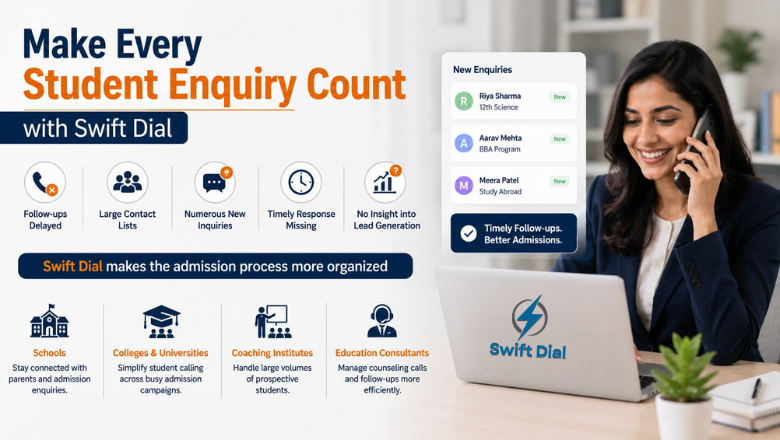
An organization can receive countless student inquiries, but such inquiries mean nothing unless the admissions team reaches out to them in a timely manner. That is precisely where the trouble lies. The counselors have large contact lists, there are numerous new inquiries coming in, follow-ups are always delayed, and the management does not have insight into lead generation.
Swift Dial Sim-Based CRM helps make this process more organized. Schools can use it to stay connected with parents and admission enquiries. Colleges and universities can simplify student calling across busy admission campaigns. Coaching institutes can handle large volumes of prospective students, while education consultants can manage regular counseling calls and follow-ups more efficiently.
FAQs
1. How does an education CRM software help schools?
An education CRM software works as a CRM for schools by organizing parent enquiries, student information, admission follow-ups, and communication.
2. What is a higher education CRM?
A higher education CRM helps colleges and universities manage prospective students, applications, counselor activities, communication, and enrollment processes.
3. How are admission CRM and Education Cloud Salesforce used?
An admissions CRM helps institutions manage the complete admission journey, while Education Cloud Salesforce provides CRM capabilities designed for education-related student and institutional processes.
4. What are the main features of an admissions CRM?
An admissions CRM usually includes lead management, student follow-ups, counselor management, communication tracking, application tracking, automation, and reporting.
5. Can a higher education CRM improve student follow-ups?
Yes. A higher education CRM helps admission teams organize student communication, schedule follow-ups, and keep prospective students engaged throughout the admission process.